

Lab Water Purification System Maintenance Plan
A laboratory can produce a full day of questionable results before an out-of-spec water reading reveals the real problem. Lab water purification system maintenance is therefore not a housekeeping task or a calendar reminder alone. It is a controlled process for protecting analytical integrity, preventing contamination, and keeping a critical utility available when staff need it.
The right maintenance plan depends on the water grade required, daily demand, incoming feedwater conditions, storage and distribution design, and the applications served. A Type I point-of-use system supporting molecular biology has different risks than a central reverse osmosis and deionization system supplying glassware washers, autoclaves, analyzers, and general laboratory use. Both require disciplined service, documented performance verification, and a response plan when quality drifts.
Why Lab Water Purification System Maintenance Matters
Water is often treated as a background utility until it compromises an assay, stains a sensitive surface, creates scale in an instrument, or introduces microbial contamination into a process. In a laboratory, those failures can result in repeated work, invalid data, delayed release decisions, equipment damage, and compliance exposure.
Purification systems do not usually fail without warning. Their performance changes as sediment loads rise, carbon media becomes exhausted, reverse osmosis membranes foul, deionization resin approaches capacity, ultraviolet lamps age, and bacteria establish themselves in tanks, loops, or low-flow branches. Monitoring trends makes those changes visible before the system reaches a point of failure.
A reliable program also protects total operating cost. Replacing a prefilter at the appropriate differential pressure is less disruptive than allowing fouling to reduce membrane performance. Sanitizing a storage tank on schedule is more controlled than responding to a microbial excursion after downstream users have already been affected.
Start With a System-Specific Maintenance Baseline
The equipment manual provides a necessary starting point, but it is not a complete maintenance strategy. Manufacturer intervals are often based on assumed feedwater quality and operating conditions. Actual replacement and sanitization intervals should be confirmed through operating data.
Begin by documenting the system configuration from incoming water through final point of use. Identify pretreatment components, RO stages, deionization vessels or cartridges, ultraviolet treatment, ultrafiltration, tanks, recirculation pumps, distribution loops, valves, point-of-use filters, and monitoring instruments. This record should show where water quality is measured and where users can introduce contamination.
Next, define acceptance criteria by use case. Resistivity or conductivity may be the primary indicator for many inorganic applications, while total organic carbon, microbial counts, endotoxin, particles, silica, chlorine, or chloramine removal may be equally important for other work. A system can display acceptable resistivity yet still be unsuitable for a microbiologically sensitive application. The quality standard must match the laboratory process, not simply the display value available on the equipment.
Establish a baseline during stable operation. Record feedwater pressure, pretreatment pressure drop, RO feed and product conductivity, reject flow, recovery rate, tank level, recirculation status, resistivity, TOC where applicable, and water-use volume. These values turn maintenance from reactive troubleshooting into trend-based control.
Verify the Instruments That Verify the Water
Sensors, flow meters, pressure gauges, and analyzers are only useful when their readings are credible. Verify calibration requirements, calibration status, and alarm setpoints for each instrument. Pay special attention to conductivity and resistivity probes, because temperature compensation, fouling, air bubbles, and poor sensor placement can distort readings.
Alarm limits should provide time to act. Setting an alarm only at the final rejection limit leaves little margin for investigation, corrective action, and documentation. A warning threshold based on a meaningful deviation from normal performance is often more useful than waiting for a complete quality failure.
Core Tasks by Treatment Stage
A maintenance plan should follow water through the treatment train. The goal is to protect downstream components while confirming that each stage performs its intended function.
Pretreatment and Feedwater Control
Sediment filtration protects valves, pumps, membranes, and resin from particulate loading. Inspect pressure drop and replace filters based on documented conditions, not appearance alone. A filter may look clean but still contribute to unacceptable pressure loss or allow fine particles to pass if it is damaged or improperly seated.
Carbon treatment is commonly used to protect RO membranes from oxidants such as chlorine and chloramine. Its condition cannot be judged reliably by visual inspection. Test for breakthrough where appropriate, verify flow conditions and contact time, and replace media or cartridges before oxidant exposure damages membrane elements. Water softeners, antiscalant systems, and chemical dosing equipment also require routine checks for salt supply, regeneration function, chemical level, feed rate, and leaks.
Reverse Osmosis Performance
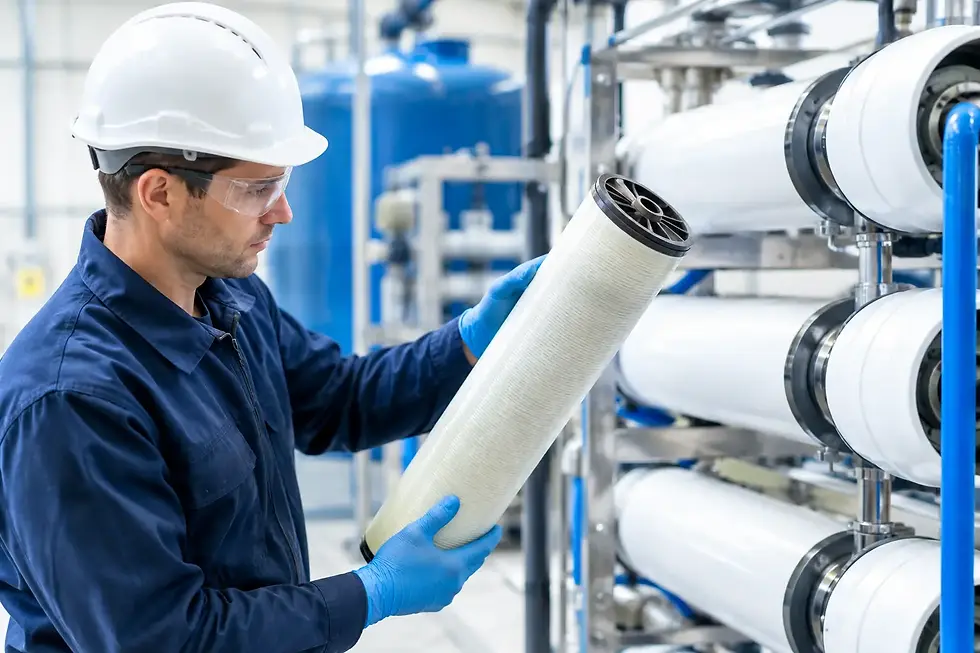
RO is a major barrier for dissolved salts, many organics, particles, and microorganisms, but membranes are sensitive to fouling, scaling, oxidant damage, and mechanical stress. Track normalized permeate flow, salt rejection, differential pressure, feed conductivity, and recovery. A decline in production or rejection may indicate a membrane issue, but it can also point to changes in feedwater temperature, pressure, pretreatment performance, or instrument accuracy.
Cleaning a membrane can recover performance when fouling is the cause. It is not a universal remedy. Chemical selection, concentration, temperature, contact time, flushing, and disposal must match the membrane material and foulant. Repeated cleaning without diagnosing the source of fouling can shorten membrane life and leave the underlying problem unresolved.
Deionization, Polishing, and Final Treatment
Mixed-bed DI cartridges and service-exchange vessels require monitoring before exhaustion. Conductivity or resistivity trends are essential, but a sudden change may also result from channeling, incorrect plumbing, resin degradation, or a failed upstream RO stage. Replace or regenerate media before product water falls outside the defined application requirement.
Ultraviolet lamps require scheduled replacement because output declines with age even when the lamp remains illuminated. If UV is used for TOC reduction, microbial control, or both, confirm the correct wavelength and monitor the relevant performance indicator. Final ultrafilters and point-of-use filters should be changed using an aseptic procedure where microbiological control matters. Improper replacement can introduce the contamination the filter is intended to prevent.
Control Microbial Risk in Tanks and Distribution Loops
A high-purity water system can produce excellent water at the treatment skid and still deliver compromised water at the point of use. Storage tanks, vent filters, dead legs, rarely used outlets, and stagnant branches create opportunities for biofilm formation.
Tank and loop maintenance should address physical design as well as sanitization frequency. Tanks should be protected from ambient contamination, vent filters should be inspected and replaced on schedule, and recirculation should be sufficient to limit stagnation. A distribution loop with oversized piping or unused branches may require design correction, not more frequent chemical treatment.
Sanitization methods must be compatible with membrane materials, resin, seals, instruments, and the laboratory's quality procedures. Chemical sanitization, heat sanitization, ozone, and ultraviolet methods each have advantages and limitations. The selected method should be validated for the system and followed by documented flushing and verification before water returns to service.
Use Records to Make Maintenance Predictable
A maintenance log should connect service actions to performance data. Record dates, component identification, lot numbers where relevant, test results, sanitization parameters, calibration activities, alarm events, corrective actions, and the person performing the work. This documentation supports internal quality reviews and makes recurring problems easier to identify.
Do not treat every abnormal result as a component replacement issue. Investigate the pattern. For example, rising product conductivity after a pretreatment change may suggest carbon breakthrough and membrane damage, while intermittent microbial results may point to a low-use outlet or sampling technique. Replacing the final cartridge may temporarily improve a result without addressing the source.
A useful review cadence is monthly for operational trends and at least annually for the full maintenance strategy. Review consumption, replacement frequency, water quality excursions, downtime, laboratory demand changes, and upcoming compliance requirements. If a lab has added instruments, expanded shifts, or changed its testing methods, the original system capacity and maintenance assumptions may no longer be appropriate.
When Service Should Escalate Beyond Routine Work
Some work can be handled by trained onsite staff, particularly routine filter changes, daily checks, and basic sampling. Escalate to qualified service support when membrane performance deteriorates, system controls behave unpredictably, contamination recurs after sanitization, pressure boundaries leak, or the system no longer meets defined quality criteria.
Facilities with regulated or mission-critical workloads benefit from a written escalation path that identifies who can take the system offline, who receives alarm notifications, what alternate water source is approved, and how users are notified. This is especially important when purified water supports clinical testing, research continuity, validated cleaning processes, or sensitive instrumentation.
The most effective maintenance plan is not the one with the most service events. It is the one that gives the laboratory clear evidence that water quality remains fit for its intended use. Keep the plan tied to real operating data, investigate changes early, and treat every water-quality trend as useful information before it becomes a disruption.


Comments