
Ultrapure Water Purification System for Laboratory
A failed assay rarely points back to the water line first. In many laboratories, though, inconsistent resistivity, elevated TOC, microbial growth, or trace ionic contamination is exactly where the problem starts. An ultrapure water purification system for laboratory use is not just a utility package - it is part of the analytical environment, and its performance directly affects accuracy, reproducibility, instrument uptime, and compliance.
For lab managers, facility teams, and procurement leaders, the real question is not whether ultrapure water matters. It is whether the system design matches the application, the building, and the operational risk profile. That is where many projects go off course. A generic unit may meet a nominal specification on paper, yet still create preventable problems in real use.
What an ultrapure water purification system for laboratory use must deliver
Laboratory water is typically discussed by grade, but the grade alone does not tell the full story. A system may be expected to produce Type I ultrapure water for critical analytical work while also supplying Type II or Type III water for general lab tasks, glassware washing, media preparation, or feed to instruments. The purification train has to support the intended use point by point, not just produce a single quality number at the cabinet.
In practice, that means controlling several contamination categories at once. Ionic contaminants affect resistivity and can interfere with chromatography, molecular biology workflows, and sensitive electrochemical methods. Organics contribute to TOC and can compromise trace analysis. Bacteria and endotoxins matter in cell culture and life science applications. Particulates can damage instruments or distort results. Dissolved gases may matter in specific methods as well.
A well-engineered system addresses these variables through staged treatment, not through a single polishing step. The usual sequence begins with pretreatment to stabilize the feedwater, then primary purification such as reverse osmosis, followed by deionization, UV oxidation, ultrafiltration, final filtration, and controlled recirculation where appropriate. The exact arrangement depends on the incoming municipal supply, usage volume, storage requirements, and the sensitivity of downstream methods.
Why feedwater and demand profile matter more than many buyers expect
Two laboratories can request the same purity specification and still need very different systems. One may have relatively stable city water with moderate hardness and low chlorine variability. Another may face seasonal conductivity swings, disinfectant changes, silica issues, or microbial loading that puts stress on membranes and resins. Designing around the desired outlet quality without accounting for the inlet conditions is a common mistake.
Usage pattern matters just as much. A small research lab drawing intermittent volumes at one point of use has a different risk profile than a multi-room facility feeding analyzers, autoclaves, clinical instruments, and wash stations throughout the day. Peak demand, standby time, distribution loop length, and the number of operators all influence system sizing and control strategy.
Oversizing creates its own problems. Water can sit too long in tanks and piping, increasing the chance of microbial growth and quality drift. Undersizing is more obvious - pressure drops, slow dispense rates, frequent consumable changes, and poor recovery after high-demand periods. The right design balances capacity, storage, recirculation, and purification stage loading based on actual operating conditions.
Core design elements that separate a lab-grade system from a basic package
A true laboratory ultrapure system is engineered around consistency. That begins with pretreatment. Sediment filtration protects downstream equipment from particulates. Activated carbon or alternative chlorine removal methods protect RO membranes and resin beds. Water softening or antiscalant strategies may be necessary where hardness, barium, strontium, or silica scaling is a concern.
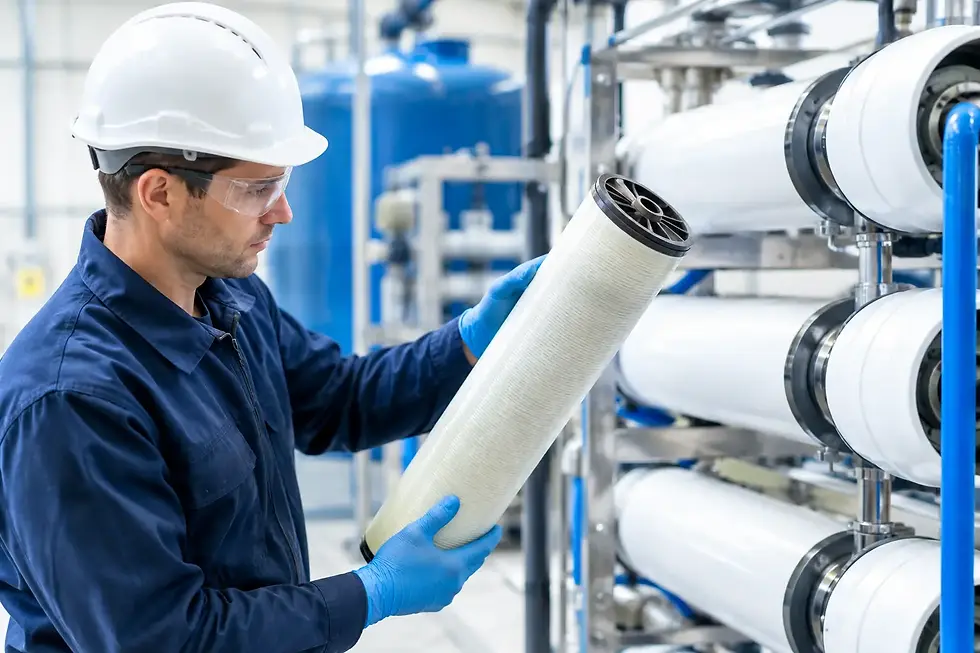
Reverse osmosis typically handles the heavy reduction load, removing a large share of dissolved solids, organics, and microbes before the polishing stages. From there, deionization raises resistivity to ultrapure levels. UV treatment at specific wavelengths can reduce microbial populations and oxidize organics, lowering TOC. Ultrafiltration becomes especially valuable for endotoxin-sensitive and nuclease-sensitive applications. Final point-of-use filtration helps control particulates and bacteria immediately before dispense.
Controls are not an accessory. Continuous monitoring of resistivity or conductivity, TOC where required, temperature, flow, pressure, and tank levels gives operators visibility into system health. Alarm logic should identify declining membrane performance, exhausted cartridges, sanitization needs, and abnormal feed conditions before water quality affects test results. In regulated or audited environments, data logging can be as important as the treatment hardware itself.
Materials of construction also deserve careful review. Wetted surfaces, tank design, loop geometry, and dead-leg control affect cleanliness and sanitization effectiveness. A low-cost storage tank with poor vent filtration or an improperly designed distribution loop can undo the benefit of high-grade purification upstream.
It depends on the application
Not every laboratory needs the same endpoint quality at every faucet. Analytical chemistry labs running HPLC, LC-MS, ICP-MS, or trace metals work often require very tight control of ions, organics, and particulates. Clinical and biomedical labs may place greater emphasis on microbial control, endotoxin management, and dependable uptime. Academic research environments can be more varied, with multiple departments sharing one infrastructure and creating competing demands.
That is why a one-size-fits-all buying approach usually underperforms. Some sites benefit from a central system feeding distribution and local polishers at critical instruments. Others are better served by dedicated point-of-use systems to isolate risk and simplify validation. In some cases, a hybrid approach is the most practical option, especially where building constraints or phased expansion are in play.
The hidden cost of choosing on purchase price alone
Procurement teams are often presented with systems that appear similar because the headline specification looks the same. Resistivity at 18.2 megohm-cm is a common example. Yet lifecycle performance can differ substantially.
Consumable replacement frequency, membrane fouling rate, sanitization complexity, service accessibility, calibration requirements, and monitoring capability all affect total cost of ownership. A lower-cost unit may consume cartridges faster because the pretreatment train is inadequate for the local feedwater. Another may require more operator intervention than the lab can realistically support. A third may meet quality targets only when freshly serviced, with wide drift between maintenance intervals.
Downtime is usually the most expensive line item, even if it does not appear on the equipment quote. Delayed testing, invalid batches, instrument troubleshooting, repeat assays, emergency bottled water purchases, and staff time spent managing quality excursions quickly outweigh a marginal savings on the original purchase.
This is why engineering-led suppliers put as much focus on serviceability and reliability as they do on purification stages. The best system is the one that performs predictably under your actual operating conditions and can be maintained without disrupting the lab.
Commissioning, validation, and service are part of system performance
An ultrapure water system is only as good as its installation and support plan. Commissioning should confirm flow, pressure, recovery, water quality performance, alarm function, and sanitization readiness. If the system feeds regulated processes, documentation expectations should be addressed early, not after installation.
Routine maintenance should be based on measured conditions and application risk, not just generic intervals. Cartridge changes, membrane performance checks, UV lamp replacement, sensor verification, tank inspection, and sanitization all have to align with usage and feedwater quality. Laboratories with limited in-house utility expertise often benefit from a partner that can manage the full lifecycle, from design through field service.
For facilities operating under quality systems, a service model with clear records and defined response times reduces operational exposure. That matters when water supports reportable test results, clinical workflows, or production-related laboratory functions.
How to evaluate an ultrapure water purification system for laboratory projects
Start with the application map. Identify which processes need Type I water, which can use lower grades, what the peak and average demand looks like, and whether the system must support future growth. Then evaluate the feedwater profile, not just a single municipal water report. Seasonal variation and disinfectant changes should be considered.
Next, review the treatment train in order. Ask how pretreatment protects the polishing stages, how the system controls microbial risk in storage and distribution, what instrumentation is included, and how quality data is recorded. Clarify sanitization methods, consumable life assumptions, and service access requirements.
Finally, evaluate the supplier's ability to support the full operating life of the system. For critical environments, design expertise, commissioning discipline, and maintenance capability matter as much as the cabinet itself. Companies such as The Water Guru are often brought in for exactly this reason - not because a lab needs a generic box, but because it needs a system engineered for the water, the workflow, and the consequence of failure.
The right laboratory water system should feel uneventful in daily operation. That is the point. When water quality is stable, documented, and matched to the application, your team can focus on the work that actually belongs on the bench.


Comments