
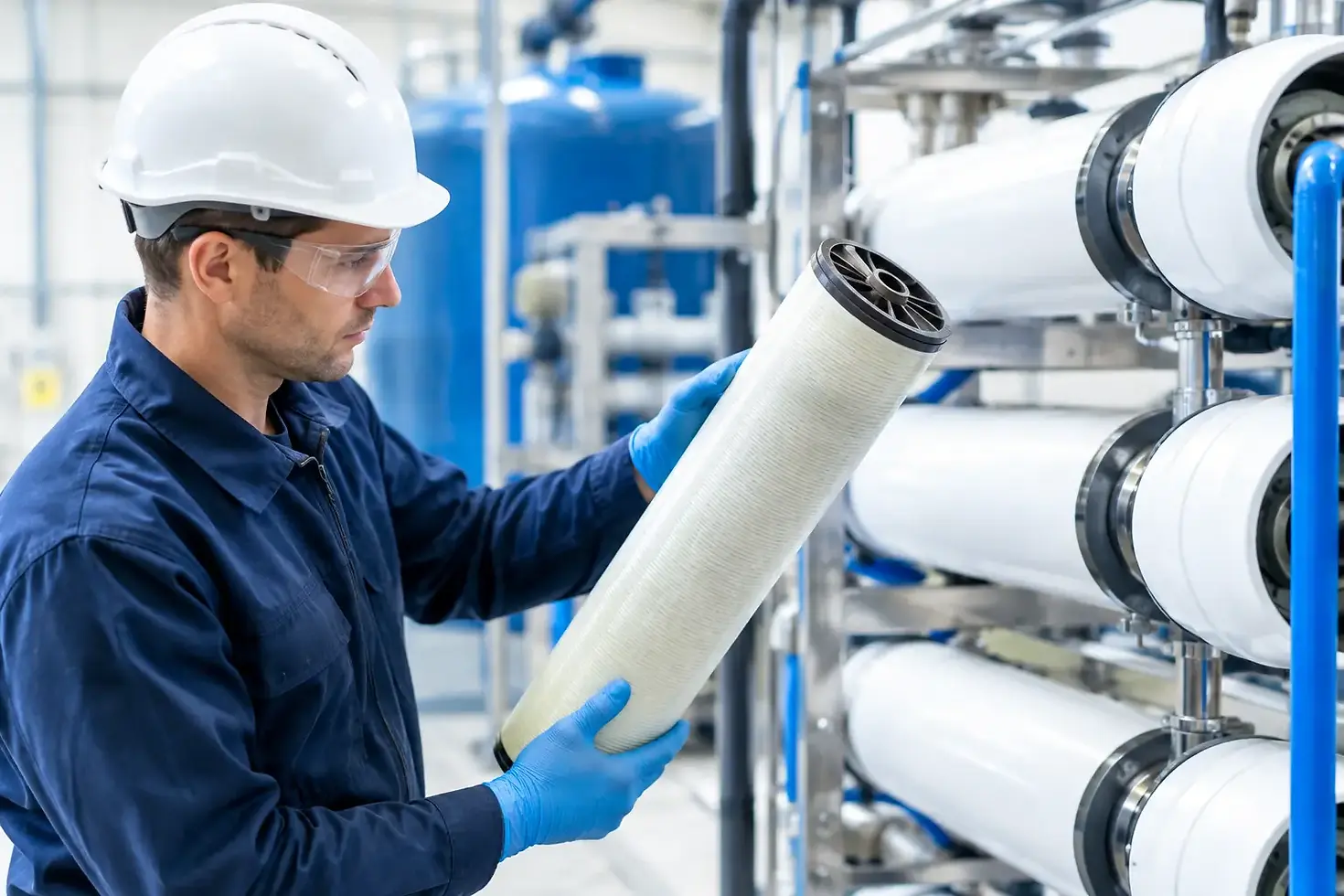
How to Reduce Membrane Fouling in RO Systems
A reverse osmosis system rarely fails without warning. Rising normalized differential pressure, declining permeate flow, increased salt passage, and more frequent cleanings usually point to a developing fouling condition. Knowing how to reduce membrane fouling means treating those trends as operating data, not as isolated maintenance events. For facilities that depend on consistent high-purity water, the objective is to control foulants before they accumulate, protect membrane life, and avoid production interruptions.
Why membrane fouling demands an engineering response
Membrane fouling occurs when material in the feedwater deposits on the membrane surface or within feed spacers. The deposited layer restricts water flow, increases pressure requirements, and can interfere with salt rejection. Left unaddressed, fouling raises energy use, shortens membrane life, and can make it difficult to maintain required water quality.
The source is not always obvious. Suspended solids, colloids, hardness scale, iron, manganese, silica, organics, biofilm, and residual oxidants can each affect an RO train differently. A system may also experience several fouling mechanisms at once. For example, inadequate particulate removal can create sites where biological material and mineral scale accumulate more readily.
That is why a generic pretreatment package or a more aggressive cleaning schedule is not a reliable answer. The appropriate control strategy depends on feedwater chemistry, seasonal source-water variation, recovery rate, membrane configuration, operating hours, and the quality requirement downstream. A dialysis water system, laboratory ultrapure water loop, food process line, and microelectronics application may all use RO, but their risk tolerances and monitoring priorities differ.
Start by identifying the fouling mechanism
Before changing chemicals, replacing membranes, or adding equipment, establish what is actually happening inside the system. Trend normalized permeate flow, normalized salt passage, normalized differential pressure, feed conductivity, temperature, recovery, and cleaning frequency. Normalization matters because temperature and pressure changes can otherwise look like performance loss.
A gradual increase in differential pressure typically suggests particulate, colloidal, or biological fouling in the feed channels. A reduction in normalized permeate flow with relatively stable differential pressure can indicate scaling or compaction, although the full operating record is needed to distinguish them. Increased salt passage may point to membrane damage, oxidant exposure, seal failure, channeling, or severe fouling that affects membrane performance.
Use water analysis and membrane evidence together
A current feedwater analysis should include the constituents relevant to the system's source and treatment objectives. Depending on the application, that may include hardness, alkalinity, silica, iron, manganese, total organic carbon, turbidity, silt density index, microbiological activity, and oxidant residual. Historical results are equally valuable because a single sample may not reflect seasonal or process-related changes.
When membrane elements are removed, autopsy findings can verify the dominant foulant. Mineral deposits, biofilm, oily residues, and fine particulates require different corrective actions. A cleaning chemical that works against carbonate scale may do little for organic fouling, and repeated cleaning with the wrong chemistry can consume time without restoring performance.
How to reduce membrane fouling with effective pretreatment
Pretreatment is the primary defense against membrane fouling. It should be designed around the water source and the recovery target rather than selected as a standard accessory package. The goal is to deliver stable feedwater within the membrane manufacturer's limits under normal conditions and during foreseeable water-quality swings.
Particulate control often begins with appropriately selected multimedia filtration, cartridge filtration, or other solids-removal technology. Cartridge filters protect the RO from larger particles, but they are not a substitute for upstream treatment when turbidity or colloidal loading is consistently high. Differential pressure across filters should be monitored so spent filters are changed before they bypass, collapse, or restrict RO feed flow.
Hardness and alkalinity control are central where scale potential is high. Ion exchange softening, acid addition, antiscalant application, or a combination of methods may be appropriate. Each option has trade-offs. Softening reduces calcium and magnesium but requires regeneration management. Antiscalants can support higher recovery, but dosing must be accurate and compatible with the feedwater chemistry. Acidification can control carbonate scaling but does not address silica or all mineral scaling risks.
Iron and manganese need particular attention because even modest concentrations can foul membranes and create conditions favorable to biofilm growth. Oxidation and media filtration may be needed ahead of RO, with dechlorination downstream if oxidants are used. Most thin-film composite RO membranes are vulnerable to free chlorine and other oxidants, so residual oxidant control must be verified, not assumed.
For surface water, variable wells, or sources with elevated organic content, additional treatment such as activated carbon, ultrafiltration, or other tailored processes may be justified. Carbon can reduce organics and oxidants, but poorly maintained carbon beds can become biological growth sites. Every pretreatment component needs an operating and sanitation plan.
Operate the RO within its design envelope
A well-designed system can still foul prematurely if it is operated outside the conditions used for design. Excessive recovery concentrates dissolved solids and increases the risk of scale. Low crossflow allows deposits to remain at the membrane surface. Extended shutdowns without preservation allow biological growth to establish in vessels, piping, and membrane elements.
Maintain feed pressure, concentrate flow, recovery, and chemical dose at documented setpoints. Do not compensate for declining production by steadily increasing feed pressure. That response may force water through a fouled membrane temporarily, but it increases mechanical stress and can make the underlying issue harder to correct.
Instrumentation should support action, not merely record values. Operators need defined alert and response limits for conductivity, differential pressure, flow, pH, oxidant residual, and tank level. A sudden conductivity change warrants immediate investigation; waiting until product water fails a downstream requirement can expose a facility to avoidable compliance or production risk.
For systems with intermittent demand, consider the hydraulic consequences of low-flow operation. Proper flushing before shutdown, automatic flush cycles, and appropriate membrane preservation during longer outages reduce the opportunity for salts and biological material to concentrate. The correct preservation method depends on the membrane type, outage duration, temperature, and applicable water-quality requirements.
Clean membranes before fouling becomes irreversible
Clean-in-place is a recovery tool, not a replacement for source control. Cleaning should be triggered by normalized performance changes against a defined baseline, following membrane manufacturer guidance and site-specific operating experience. Delaying cleaning until permeate flow collapses can make deposits more difficult to remove and increase the chance of permanent loss.
A disciplined cleaning procedure accounts for chemical selection, concentration, pH, temperature, circulation flow, soak time, rinse quality, and disposal requirements. Acid cleaners are commonly used for mineral scale, while alkaline or surfactant-based formulations may be used for organic and biological fouling. Some conditions require a staged sequence. Chemical compatibility with the membrane, vessels, seals, and piping is essential.
Document pre-cleaning and post-cleaning normalized data. If cleaning restores little performance, do not simply repeat the same process. Review the foulant diagnosis, chemical strength, temperature, circulation velocity, and pretreatment performance. Persistent poor recovery can also indicate membrane damage or a mechanical issue rather than removable fouling.
Build membrane protection into routine maintenance
Membrane reliability depends on consistent field practices. A preventive maintenance program should verify chemical inventory and feed calibration, inspect filter condition, test oxidant removal, check instrument accuracy, review operating trends, and confirm that alarms are meaningful. It should also define responsibilities during shift changes, source-water events, and shutdowns.
Facilities should retain baseline commissioning data and update operating records after major changes, including new production equipment, shifts in water demand, well modifications, municipal source changes, or pretreatment repairs. These events can alter loading on an RO system even when the unit itself has not changed.
In regulated and performance-sensitive environments, maintenance records also support traceability. For healthcare, laboratory, food and beverage, and manufacturing operations, the ability to demonstrate controlled water treatment can be as valuable as the treatment result itself. The Water Guru approaches membrane protection as a lifecycle engineering function, connecting feedwater assessment, system design, commissioning, and service requirements.
The most effective fouling strategy is rarely the most aggressive one. It is the one that keeps feedwater stable, maintains the intended hydraulic conditions, detects deviation early, and responds with evidence-based corrective action. When membrane performance is managed this way, cleaning becomes planned maintenance rather than an emergency response.



Comments